
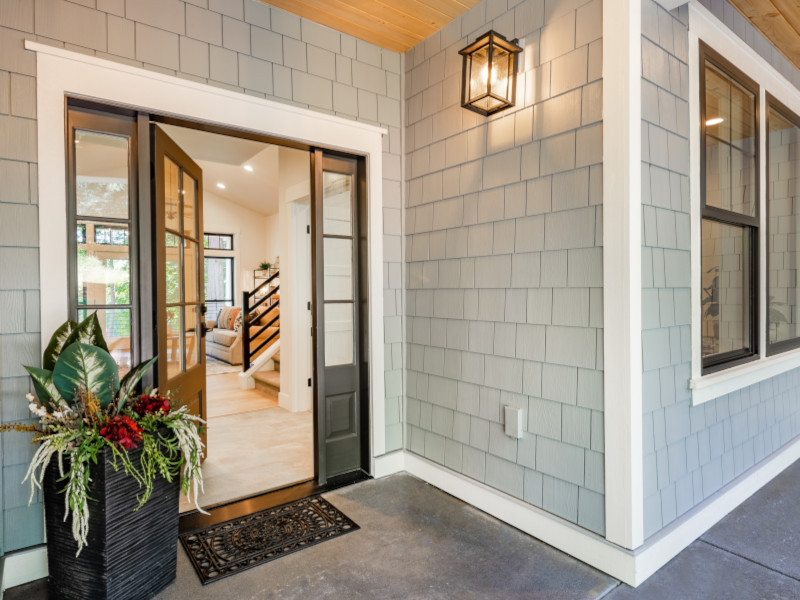
Many people spend an excessive amount of time choosing the right paint for their interior rooms that no one else will see, rather than focusing on the front door – this should be the other way around. The front door is the one part of your home that every guest or potential buyer will come into contact with. It is what keeps every passerby’s eyes fixed on your home.
Not just an entry-point, the front door serves as a metaphorical handshake between your home and its visitor. It is the first thing that anyone will physically encounter in your home, and therefore it sets the tone for everything that is to come. This really does all come down to that one rectangle of hardware and material.
Why the door is the focal point, not just a feature
There’s a reason why a lot of advice on increasing curb appeal focuses on the entryway – that’s the focal point of the home’s exterior. It’s the one element that catches the eye first, and first impressions matter a lot.
Read More: How Much Energy Do Automatic Hand Dryers Actually Use?
But when the door is right – when the proportions are good and the material’s quality and the design fit the context of your home – then the door just anchors the whole composition. The eye moves out and around the door to the other elements and back again. It doesn’t get stopped short, bottlenecked. When it doesn’t work – wrong scale, wrong material, wrong relationship to the architecture – nothing else on the facade can compensate. You can have perfect landscaping and fresh exterior paint, but a cheap or mismatched door still reads as cheap and mismatched.
Architectural alignment comes before personal preference
This is where many door upgrades miss the mark. Yes, that door is stunning and modern, with skinny vertical panes of glass – but you live in a charming Craftsman bungalow with broad eaves and decorative bracketing. That door isn’t inherently wrong. But it is wrong for that house.
The architectural style of your home dictates the language your new door should speak. A Colonial demands symmetry, raised panels, and stately proportions. A modern build can handle a door that’s flush, low profile, and nearly disappears with simple handle hardware. A farmhouse or Craftsman property reads very well with a door that’s got a bit of warmth and texture to it, like wood exterior doors.
Getting this right doesn’t require a designer. Just step back and look at some of the existing cues and features on your home. Feet of window trim inside? What profile does it have? Shingle siding with pretty, heavy wood shakes? Roofline that looks like it was hand-hewn and has taken on a life of its own? Respond to that.
Material choice signals quality immediately
Artificial doors have gotten better, but we’re not there yet. Fiberglass and steel doors, even when specced with stunning wood-look grains and patinas, still catch the sun differently than real wood under direct sunlight. The same goes for product images in glossy magazines. The grain patterns on embossed fiberglass can play the part, look the part in a professional photograph. In person, at close range, they can’t be the part.
Real wood has that indefinable something that only comes from a natural material. It has depth. Light falls on it differently at different times of day. The grain, the variation, the weight of it. The heft of wood has been shown to be a more persuasive subconscious indicator of quality craftsmanship than paper specs or price tags.
Read More: 5 Critical Maintenance Tips to Ensure Your Backup Power System Stays Reliable
Solid wood has always been the luxury door material, but modern engineered wood cores – many constructed in efficient, waste-averse layers – solve solid wood’s warping and swelling and seasonal movement issues handily. All of the parts of the door that care about your local weather are engineered to resist it. The part that’s just about you, your house, your aesthetic, is that outermost face of the door. And that’s real wood.
The framing elements: supporting roles, not lead roles
The door should be a statement on its own, but one that integrates with the home’s architectural style. A good rule of thumb is that the door style can either stand in contrast to the rest of the home (a modern door on a craftsman facade, for example) so long as colors and materials still complement. Or the door can quietly complement the style of the home, becoming a subtle nod to the beautiful design waiting inside.
Ultimately, the front door’s job is to draw your eye, entice you to enter, and, most importantly, to get you excited about what awaits once you do.
The financial case for getting this right
An upgrade to your front door should not be taken lightly. According to the Remodeling 2023 Cost vs. Value Report, a premium front door replacement is one of the highest-ROI home improvement projects. Many homeowners recoup more than 100% of the cost on the added value at resale.
Of course, that return on investment is much easier to understand when you see exactly what potential buyers are responding to. The front door is what causes someone to stop scrolling through listings and start scheduling visits. It builds the excitement before they’ve even looked at a single photo of the interior. A premium entrance does more than simply look impressive on a cost-to-value analysis; it reduces days on the market by drawing in potential buyers from the very first point of contact.
It’s not a capstone to your other efforts; it’s the cornerstone. The door is what the rest of your home is measured against in terms of perceived value, and what makes the biggest impression in the buyer’s mind.